CTCF HT-SELEX (Jolma et al. 2013) | Model training
import os
%load_ext autoreload
%autoreload 2
The autoreload extension is already loaded. To reload it, use:
  %reload_ext autoreload
cd ~/workspace/theislab/mubind/docs/notebooks/batch
/home/ilibarra/workspace/theislab/mubind/docs/notebooks/batch
import mubind as mb
import numpy as np
import pandas as pd
import torch
import bindome as bd
bd.constants.ANNOTATIONS_DIRECTORY = 'annotations' # '../../annotations'
# mb.models.Mubind
import torch.optim as topti
import torch.utils.data as tdata
import numpy as np

# Use a GPU if available, as it should be faster.
device = torch.device("cuda:0" if torch.cuda.is_available() else "cpu")
print("Using device: " + str(device))
Using device: cuda:0
df = mb.bindome.datasets.ProBound.ctcf(flank_length=0)
df = df.sort_values(1, ascending=False).reset_index(drop=True)

# data = df.head(1000)
# data = df.copy()

df.index = df['seq']
del df['seq']
df.index = df.index.astype(str).str[45:]

df = df[~df.index.duplicated(keep='first')]

n_sample = 10000
if n_sample is not None:
    data = df.sample(min(df.shape[0], n_sample))
else:
    data = df.copy()

# data = mb.pp.sample_rounds(df, 2, 10000)

# remove as many nucleotides as posisble (faster training/convergence)


# data.index = data.index.astype(str).str[-15:]
data.shape
(10000, 2)
from matplotlib import rcParams
rcParams['figure.figsize'] = 5, 1
# TODO: skipped for now
n_rounds = 2

print('loading object (# entries)', data.shape[0])
dataset = mb.datasets.SelexDataset(data, n_rounds=n_rounds, labels=[0, 1])
train = tdata.DataLoader(dataset=dataset,
                         # batch_size=256,
                         batch_size=625,
                         shuffle=False)
loading object (# entries) 10000
import warnings
warnings.filterwarnings('ignore')
# %lprun -f mb.tl.train_network mb.tl.train_network(model, train, device, next_optimiser, criterion, num_epochs=20, early_stopping=100, log_each=2, dirichlet_regularization=0, exp_max=40, verbose=0)
# %lprun -f mb.tl.train_iterative mb.tl.train_iterative(train, device, w=18, show_logo=False, opt_kernel_shift=0, opt_kernel_length=0, dirichlet_regularization=dirichlet_regularization, lr=[0.01, 0.01], weight_decay=[0.01, 0.001], ignore_kernel=ignore_kernel, num_epochs=2, early_stopping=100, use_dinuc=False, n_kernels=n_kernels, log_each=log_each, stop_at_kernel=None)
pd.set_option('display.expand_frame_repr', False)
# assign batch and data type

# data['batch'] = 0
# data['is_count_data'] = 1
# n_batches=3

dirichlet_regularization = 0
# for dirichlet_regularization_log in range(-5, 3):

n_epochs = 350
log_each = 100
n_kernels = 2
lr = [0.01] * n_kernels
kernels = [0, 2] + [20] * (n_kernels - 1)
# kernels = [0, 2] + [20] * (n_kernels - 1)
wd = [0.01,] + [0.001] * (n_kernels - 1)
early_stopping = [5,] + [10] * (n_kernels)

opt_kernel_shift = [0, 0] + [1] * (n_kernels - 1)
# opt_kernel_shift = [0, 0] + [0] * (n_kernels - 1)
opt_kernel_length = [0, 0] + [1] * (n_kernels - 1)
# opt_kernel_length = [0, 0] + [0] * (n_kernels - 1)
use_mono = True
use_dinuc = False
use_conv1d = True
dinuc_mode = None # 'local'

from matplotlib import rcParams
rcParams['figure.figsize'] = 8, 1

import time
t0 = time.time()

criterion = mb.tl.PoissonLoss()
import itertools

models = []

for optimize_exp_barrier, optimize_kernel_rel, optimize_sym_weight in list(itertools.product([False, True], repeat=3)):

    print(optimize_exp_barrier, optimize_kernel_rel, optimize_sym_weight)
    model = mb.models.Mubind.make_model(train, n_kernels, criterion, kernels=kernels,
                                        use_conv1d=use_conv1d,
                                           use_dinuc=use_dinuc, dinuc_mode=dinuc_mode,
                                           optimize_exp_barrier= optimize_exp_barrier,
                                           optimize_kernel_rel = optimize_kernel_rel,
                                           optimize_sym_weight = optimize_sym_weight).cuda()
    # print(model)
    t0 = time.time()

    # assert False
    model, best_loss = model.optimize_iterative(train,
                                                optimiser=torch.optim.LBFGS,
                                                show_logo=0,
                                                r2_per_epoch=True,
                                                opt_kernel_length=opt_kernel_length,
                                                opt_kernel_shift=opt_kernel_shift,
                                                dirichlet_regularization=dirichlet_regularization, # 10 ** dirichlet_regularization_log,
                                                # lr=lr, weight_decay=wd, ignore_kernel=ignore_kernel,
                                                # skip_kernels={2, 3},
                                                n_epochs=n_epochs,
                                                early_stopping=early_stopping, # optimiser=torch.optim.LBFGS,
                                                log_each=log_each,
                                                stop_at_kernel=None) #  seed=seed) # seeds.index[0]) #
    print('##DONE....\n\n')

    total_time = time.time() - t0
    print(f'total time: {total_time}s')
    # print('total time: %.3f s' % ((time.time() - t0)))
    # # res = []
    # # model_by_k = {}
    #
    # counts = mb.tl.predict(model, train)
    # print(counts)
    #
    mb.pl.set_rcParams({'figure.figsize': [10, 6], 'figure.dpi': 65})
    # mb.pl.logo(model)
    #
    # mb.tl.scores(model, train, by='batch')
    mb.pl.set_rcParams({'figure.figsize': [6, 6], 'figure.dpi': 85})
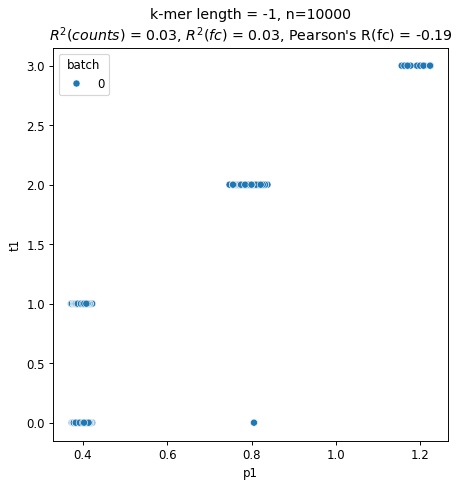
    mb.pl.kmer_enrichment(model, train, log_scale=False, style='scatter', ylab='t1', xlab='p1')
    # mb.pl.activities(model)
    #
    # mb.pl.set_rcParams({'figure.figsize': [8, 4], 'figure.dpi': 85})
    # mb.pl.loss(model)

    models.append([model, best_loss])
    break

    # break
False False False
Using device: cuda:0
verbose=2
current kernel 0

### next filter to optimize 0 (intercept)

FREEZING KERNELS
optimizing feature type mono
next kernels 0-0, n=1
setting grad status of kernel (mono, dinuc) at 0 to (1, 0)
filters mask None
optimizer:  LBFGS , criterion: PoissonLoss
epochs: 350
early_stopping: 5
lr= 0.01, dir weight= 0
2%|███▊ | 7/350 [00:02<01:47, 3.18it/s]
Epoch:  8, Loss: 0.843, R2: 0.038,  best epoch: 2,  secs per epoch: 0.320s,  secs epoch*1k trials: 0.032s, curr time: 2024-07-19 01:29:00.412981
early stop!
Current time: 2024-07-19 01:29:00.459925
	Loss: 0.843 , R2: 0.038
	Training time (model/function): (2.237s / 2.237s)
		per epoch (model/function): (0.320s/ 0.320s)
		per 1k samples: 0.032s
('etas corr with lib_sizes (before refinement)', SignificanceResult(statistic=0.9999999999999999, pvalue=nan))
optimization of dinuc is not valid for the intercept (filter=0). Skip...
current kernel 1

### next filter to optimize 1

FREEZING KERNELS
optimizing feature type mono
next kernels 1-1, n=1
setting grad status of kernel (mono, dinuc) at 1 to (1, 0)
filters mask None
optimizer:  LBFGS , criterion: PoissonLoss
epochs: 350
early_stopping: 10
lr= 0.01, dir weight= 0
1%|█ | 2/350 [00:00<00:54, 6.40it/s]
Epoch:  3, Loss: 0.843, R2: 0.036,  best epoch: 2,  secs per epoch: 0.173s,  secs epoch*1k trials: 0.017s, curr time: 2024-07-19 01:29:00.807608
early stop!
Current time: 2024-07-19 01:29:00.853715
	Loss: 0.843 , R2: 0.036
	Training time (model/function): (2.583s / 0.346s)
		per epoch (model/function): (1.292s/ 0.173s)
		per 1k samples: 0.017s
('etas corr with lib_sizes (before refinement)', SignificanceResult(statistic=0.9999999999999999, pvalue=nan))


final refinement step (after shift)...unfreezing all layers
optimizer:  LBFGS , criterion: PoissonLoss
epochs: 350
early_stopping: 10
lr= 0.01, dir weight= 0
2%|████▍ | 8/350 [00:00<00:24, 13.71it/s]
Epoch:  9, Loss: 0.843, R2: 0.036,  best epoch: 1,  secs per epoch: 0.077s,  secs epoch*1k trials: 0.008s, curr time: 2024-07-19 01:29:01.470789
early stop!
Current time: 2024-07-19 01:29:01.517509
	Loss: 0.843 , R2: 0.036
	Training time (model/function): (3.200s / 0.616s)
		per epoch (model/function): (0.400s/ 0.077s)
		per 1k samples: 0.008s
best loss 0.843
last five r2 values, by sequential filter optimization: ['0.036']
('etas corr with lib_sizes (before refinement)', SignificanceResult(statistic=0.9999999999999999, pvalue=nan))
optimizing feature type dinuc
the optimization of dinucleotide features is skipped...
current kernel 2

### next filter to optimize 2

FREEZING KERNELS
optimizing feature type mono
next kernels 2-2, n=1
setting grad status of kernel (mono, dinuc) at 2 to (1, 0)
filters mask None
optimizer:  LBFGS , criterion: PoissonLoss
epochs: 350
early_stopping: 10
lr= 0.01, dir weight= 0
3%|██████ | 11/350 [00:01<00:34, 9.76it/s]
Epoch: 12, Loss: 0.843, R2: 0.035,  best epoch: 1,  secs per epoch: 0.106s,  secs epoch*1k trials: 0.011s, curr time: 2024-07-19 01:29:02.725215
early stop!
Current time: 2024-07-19 01:29:02.771701
	Loss: 0.843 , R2: 0.035
	Training time (model/function): (4.361s / 1.162s)
		per epoch (model/function): (0.396s/ 0.106s)
		per 1k samples: 0.011s

WIDTH OPTIMIZATION (first)...
Reached maximum w. Stop...

SHIFT OPTIMIZATION (first)...
options to try [[0, 0, -2], [0, 0, -1], [0, 0, 0], [0, 0, 1], [0, 0, 2]]
next expand left: 0, next expand right: 0, shift: -2
optimizer:  LBFGS , criterion: PoissonLoss
epochs: 350
early_stopping: 10
lr= 0.01, dir weight= 0
3%|█████▍ | 10/350 [00:01<00:39, 8.66it/s]
Epoch: 11, Loss: 0.843, R2: 0.031,  best epoch: 1,  secs per epoch: 0.119s,  secs epoch*1k trials: 0.012s, curr time: 2024-07-19 01:29:03.960944
early stop!
Current time: 2024-07-19 01:29:04.012319
	Loss: 0.843 , R2: 0.031
	Training time (model/function): (5.549s / 1.188s)
		per epoch (model/function): (0.555s/ 0.119s)
		per 1k samples: 0.012s

next expand left: 0, next expand right: 0, shift: -1
optimizer:  LBFGS , criterion: PoissonLoss
epochs: 350
early_stopping: 10
lr= 0.01, dir weight= 0
3%|██████ | 11/350 [00:01<00:35, 9.54it/s]
Epoch: 12, Loss: 0.843, R2: 0.032,  best epoch: 1,  secs per epoch: 0.108s,  secs epoch*1k trials: 0.011s, curr time: 2024-07-19 01:29:05.245064
early stop!
Current time: 2024-07-19 01:29:05.291451
	Loss: 0.843 , R2: 0.032
	Training time (model/function): (5.548s / 1.187s)
		per epoch (model/function): (0.504s/ 0.108s)
		per 1k samples: 0.011s

next expand left: 0, next expand right: 0, shift: 0
optimizer:  LBFGS , criterion: PoissonLoss
epochs: 350
early_stopping: 10
lr= 0.01, dir weight= 0
3%|██████ | 11/350 [00:01<00:35, 9.67it/s]
Epoch: 12, Loss: 0.843, R2: 0.033,  best epoch: 1,  secs per epoch: 0.107s,  secs epoch*1k trials: 0.011s, curr time: 2024-07-19 01:29:06.510200
early stop!
Current time: 2024-07-19 01:29:06.575430
	Loss: 0.843 , R2: 0.033
	Training time (model/function): (5.534s / 1.173s)
		per epoch (model/function): (0.503s/ 0.107s)
		per 1k samples: 0.011s

next expand left: 0, next expand right: 0, shift: 1
optimizer:  LBFGS , criterion: PoissonLoss
epochs: 350
early_stopping: 10
lr= 0.01, dir weight= 0
3%|██████ | 11/350 [00:01<00:35, 9.49it/s]
Epoch: 12, Loss: 0.843, R2: 0.032,  best epoch: 1,  secs per epoch: 0.108s,  secs epoch*1k trials: 0.011s, curr time: 2024-07-19 01:29:07.819782
early stop!
Current time: 2024-07-19 01:29:07.865571
	Loss: 0.843 , R2: 0.032
	Training time (model/function): (5.555s / 1.193s)
		per epoch (model/function): (0.505s/ 0.108s)
		per 1k samples: 0.011s

next expand left: 0, next expand right: 0, shift: 2
optimizer:  LBFGS , criterion: PoissonLoss
epochs: 350
early_stopping: 10
lr= 0.01, dir weight= 0
1%|█▋ | 3/350 [00:00<01:01, 5.63it/s]
Epoch:  4, Loss: 0.843, R2: 0.031,  best epoch: 3,  secs per epoch: 0.188s,  secs epoch*1k trials: 0.019s, curr time: 2024-07-19 01:29:08.477130
early stop!
Current time: 2024-07-19 01:29:08.522598
	Loss: 0.843 , R2: 0.031
	Training time (model/function): (4.927s / 0.566s)
		per epoch (model/function): (1.642s/ 0.189s)
		per 1k samples: 0.019s

filter rearrangments (sorted by observed r2)
   expand.left  expand.right  shift  pos_w_sum  width  loss_diff_pct      loss        r2  last_loss
4            0             0      0   2.187485     20       0.004813  0.842726  0.032970   0.842767
5            0             0      0   2.068837     20       0.000000  0.842767  0.034548   0.842767
2            0             0     -1   2.098160     20      -0.001365  0.842778  0.031740   0.842767
0            0             0     -2   2.080549     20      -0.002813  0.842790  0.030823   0.842767
3            0             0      1   2.100226     20      -0.003085  0.842793  0.031758   0.842767
1            0             0      2   2.068837     20      -0.007344  0.842828  0.030900   0.842767
0 0 0 2.1874847412109375 20 0.004812834829732442 0.8427259624004364 0.03297001123428345
action (expand left, expand right, shift): (0, 0, 0)

This was the last iteration. Done with filter shift optimization...
('etas corr with lib_sizes (before refinement)', SignificanceResult(statistic=0.9999999999999999, pvalue=nan))


final refinement step (after shift)...unfreezing all layers
optimizer:  LBFGS , criterion: PoissonLoss
epochs: 350
early_stopping: 10
lr= 0.01, dir weight= 0
1%|██▋ | 5/350 [00:00<00:47, 7.25it/s]
Epoch:  6, Loss: 0.843, R2: 0.032,  best epoch: 5,  secs per epoch: 0.145s,  secs epoch*1k trials: 0.014s, curr time: 2024-07-19 01:29:09.342548
early stop!
Current time: 2024-07-19 01:29:09.388243
	Loss: 0.843 , R2: 0.032
	Training time (model/function): (6.259s / 0.725s)
		per epoch (model/function): (1.252s/ 0.145s)
		per 1k samples: 0.015s
best loss 0.843
last five r2 values, by sequential filter optimization: ['0.036', '0.032']
('etas corr with lib_sizes (before refinement)', SignificanceResult(statistic=0.9999999999999999, pvalue=nan))
optimizing feature type dinuc
the optimization of dinucleotide features is skipped...

optimization finished:
total time: 6.259434938430786s
Time per epoch (total): 0.018 s
##DONE....


total time: 11.258373975753784s
%load_ext line_profiler
The line_profiler extension is already loaded. To reload it, use:
  %reload_ext line_profiler
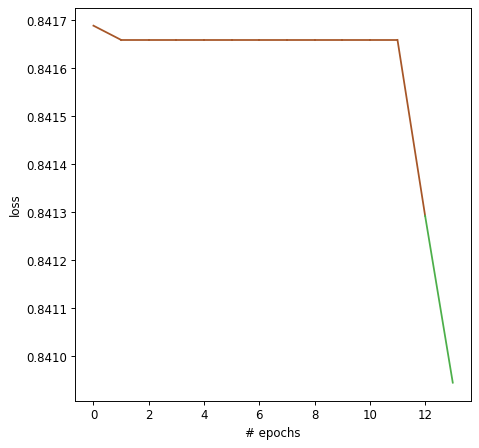
mb.pl.loss(model)
# %lprun -f model.graph_module.forward model.optimize_iterative(train, show_logo=0, r2_per_epoch=True, opt_kernel_length=opt_kernel_length, opt_kernel_shift=opt_kernel_shift, dirichlet_regularization=dirichlet_regularization, n_epochs=n_epochs, early_stopping=early_stopping, log_each=log_each, stop_at_kernel=None) # seed=seed) # seeds.index[0]) #
for m, best_loss in models:
    print(m.optimize_exp_barrier, m.optimize_kernel_rel, m.optimize_sym_weight, m.r2_final, m.total_time)
False False False 0.040788471698760986 26.84837031364441
rcParams['figure.figsize'] = 20, 5
for m, best_loss in models:
    #print(m.optimize_exp_barrier, m.optimize_kernel_rel, m.optimize_sym_weight, m.r2_final, m.total_time)
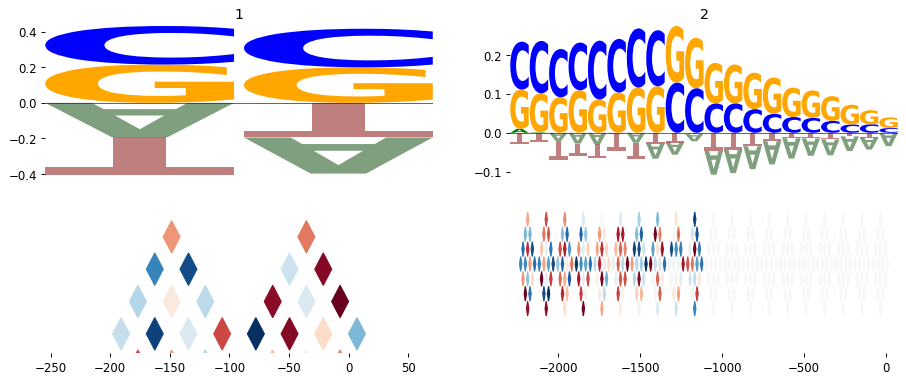
    mb.pl.logo(m, flip=True)
True
3
order None
0 out of 3...
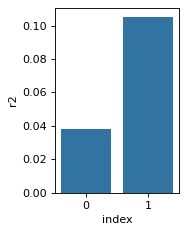
# contributions per newly added kernel
rcParams['figure.figsize'] = 2, 3
rcParams['figure.dpi'] = 80
import seaborn as sns
r2 = pd.DataFrame(model.best_r2_by_new_filter, columns=['r2']).reset_index()
sns.barplot(data=r2, x='index', y='r2')
<Axes: xlabel='index', ylabel='r2'>
import matplotlib.pyplot as plt
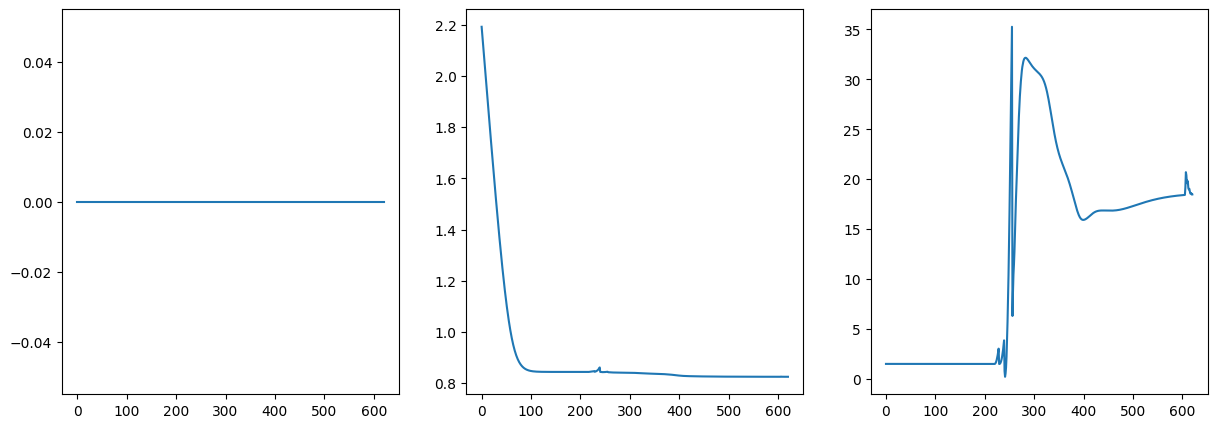
rcParams['figure.figsize'] = 20, 5
rcParams['figure.dpi'] = 100

plt.subplot(1, 4, 1)
plt.plot(model.loss_history_log_dynamic)
plt.subplot(1, 4, 2)
plt.plot(model.loss_history)
plt.subplot(1, 4, 3)
plt.plot(model.loss_history_sym_weights)
[<matplotlib.lines.Line2D at 0x7d59312a06d0>]
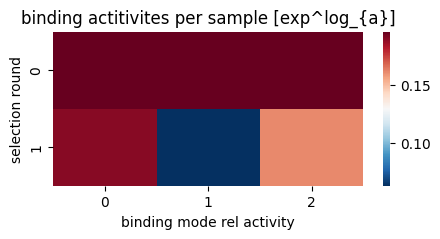
model.get_log_activities()
tensor([[[-1.4364e-08, -2.8094e-02],
         [ 2.3709e-06, -1.1344e+00],
         [ 1.8790e-03, -1.9220e-01]]], device='cuda:0',
       grad_fn=<StackBackward0>)
model.binding_modes
BindingLayer(
  (conv_mono): ModuleList(
    (0): None
    (1): Conv1d(4, 1, kernel_size=(2,), stride=(1,), bias=False)
    (2): Conv1d(4, 1, kernel_size=(20,), stride=(1,), bias=False)
  )
  (conv_di): ModuleList(
    (0): None
    (1): Conv1d(16, 1, kernel_size=(2,), stride=(1,), bias=False)
    (2): Conv1d(16, 1, kernel_size=(20,), stride=(1,), bias=False)
  )
)
rcParams['figure.figsize'] = 5, 2
mb.pl.activities(model, cmap='RdBu_r')
0
import anndata
adata = anndata.AnnData(data.T)
import scanpy as sc
sc.pp.neighbors(adata)
sc.tl.umap(adata)
WARNING: n_obs too small: adjusting to `n_neighbors = 2`
WARNING: You’re trying to run this on 2500 dimensions of `.X`, if you really want this, set `use_rep='X'`.
         Falling back to preprocessing with `sc.pp.pca` and default params.
---------------------------------------------------------------------------
ValueError                                Traceback (most recent call last)
Cell In[213], line 1
----> 1 sc.pp.neighbors(adata)
      2 sc.tl.umap(adata)

File ~/miniconda3/envs/mubind/lib/python3.9/site-packages/scanpy/neighbors/__init__.py:176, in neighbors(adata, n_neighbors, n_pcs, use_rep, knn, method, transformer, metric, metric_kwds, random_state, key_added, copy)
    174     adata._init_as_actual(adata.copy())
    175 neighbors = Neighbors(adata)
--> 176 neighbors.compute_neighbors(
    177     n_neighbors,
    178     n_pcs=n_pcs,
    179     use_rep=use_rep,
    180     knn=knn,
    181     method=method,
    182     transformer=transformer,
    183     metric=metric,
    184     metric_kwds=metric_kwds,
    185     random_state=random_state,
    186 )
    188 if key_added is None:
    189     key_added = "neighbors"

File ~/miniconda3/envs/mubind/lib/python3.9/site-packages/scanpy/neighbors/__init__.py:560, in Neighbors.compute_neighbors(self, n_neighbors, n_pcs, use_rep, knn, method, transformer, metric, metric_kwds, random_state)
    558 self.n_neighbors = n_neighbors
    559 self.knn = knn
--> 560 X = _choose_representation(self._adata, use_rep=use_rep, n_pcs=n_pcs)
    561 self._distances = transformer.fit_transform(X)
    562 knn_indices, knn_distances = _get_indices_distances_from_sparse_matrix(
    563     self._distances, n_neighbors
    564 )

File ~/miniconda3/envs/mubind/lib/python3.9/site-packages/scanpy/tools/_utils.py:46, in _choose_representation(adata, use_rep, n_pcs, silent)
     40         logg.warning(
     41             f"You’re trying to run this on {adata.n_vars} dimensions of `.X`, "
     42             "if you really want this, set `use_rep='X'`.\n         "
     43             "Falling back to preprocessing with `sc.pp.pca` and default params."
     44         )
     45         n_pcs_pca = n_pcs if n_pcs is not None else settings.N_PCS
---> 46         X = pca(adata.X, n_comps=n_pcs_pca)
     47         adata.obsm["X_pca"] = X
     48 else:

File ~/miniconda3/envs/mubind/lib/python3.9/site-packages/scanpy/preprocessing/_pca.py:270, in pca(***failed resolving arguments***)
    266         X = X.toarray()
    267     pca_ = PCA(
    268         n_components=n_comps, svd_solver=svd_solver, random_state=random_state
    269     )
--> 270     X_pca = pca_.fit_transform(X)
    271 elif issparse(X) and zero_center:
    272     from sklearn.decomposition import PCA

File ~/miniconda3/envs/mubind/lib/python3.9/site-packages/sklearn/utils/_set_output.py:313, in _wrap_method_output.<locals>.wrapped(self, X, *args, **kwargs)
    311 @wraps(f)
    312 def wrapped(self, X, *args, **kwargs):
--> 313     data_to_wrap = f(self, X, *args, **kwargs)
    314     if isinstance(data_to_wrap, tuple):
    315         # only wrap the first output for cross decomposition
    316         return_tuple = (
    317             _wrap_data_with_container(method, data_to_wrap[0], X, self),
    318             *data_to_wrap[1:],
    319         )

File ~/miniconda3/envs/mubind/lib/python3.9/site-packages/sklearn/base.py:1473, in _fit_context.<locals>.decorator.<locals>.wrapper(estimator, *args, **kwargs)
   1466     estimator._validate_params()
   1468 with config_context(
   1469     skip_parameter_validation=(
   1470         prefer_skip_nested_validation or global_skip_validation
   1471     )
   1472 ):
-> 1473     return fit_method(estimator, *args, **kwargs)

File ~/miniconda3/envs/mubind/lib/python3.9/site-packages/sklearn/decomposition/_pca.py:474, in PCA.fit_transform(self, X, y)
    451 @_fit_context(prefer_skip_nested_validation=True)
    452 def fit_transform(self, X, y=None):
    453     """Fit the model with X and apply the dimensionality reduction on X.
    454
    455     Parameters
   (...)
    472     C-ordered array, use 'np.ascontiguousarray'.
    473     """
--> 474     U, S, _, X, x_is_centered, xp = self._fit(X)
    475     if U is not None:
    476         U = U[:, : self.n_components_]

File ~/miniconda3/envs/mubind/lib/python3.9/site-packages/sklearn/decomposition/_pca.py:548, in PCA._fit(self, X)
    546     return self._fit_full(X, n_components, xp, is_array_api_compliant)
    547 elif self._fit_svd_solver in ["arpack", "randomized"]:
--> 548     return self._fit_truncated(X, n_components, xp)

File ~/miniconda3/envs/mubind/lib/python3.9/site-packages/sklearn/decomposition/_pca.py:723, in PCA._fit_truncated(self, X, n_components, xp)
    718     raise ValueError(
    719         "n_components=%r cannot be a string with svd_solver='%s'"
    720         % (n_components, svd_solver)
    721     )
    722 elif not 1 <= n_components <= min(n_samples, n_features):
--> 723     raise ValueError(
    724         "n_components=%r must be between 1 and "
    725         "min(n_samples, n_features)=%r with "
    726         "svd_solver='%s'"
    727         % (n_components, min(n_samples, n_features), svd_solver)
    728     )
    729 elif svd_solver == "arpack" and n_components == min(n_samples, n_features):
    730     raise ValueError(
    731         "n_components=%r must be strictly less than "
    732         "min(n_samples, n_features)=%r with "
    733         "svd_solver='%s'"
    734         % (n_components, min(n_samples, n_features), svd_solver)
    735     )

ValueError: n_components=50 must be between 1 and min(n_samples, n_features)=2 with svd_solver='arpack'
adata
AnnData object with n_obs × n_vars = 5000 × 2
    uns: 'neighbors'
    obsp: 'distances', 'connectivities'
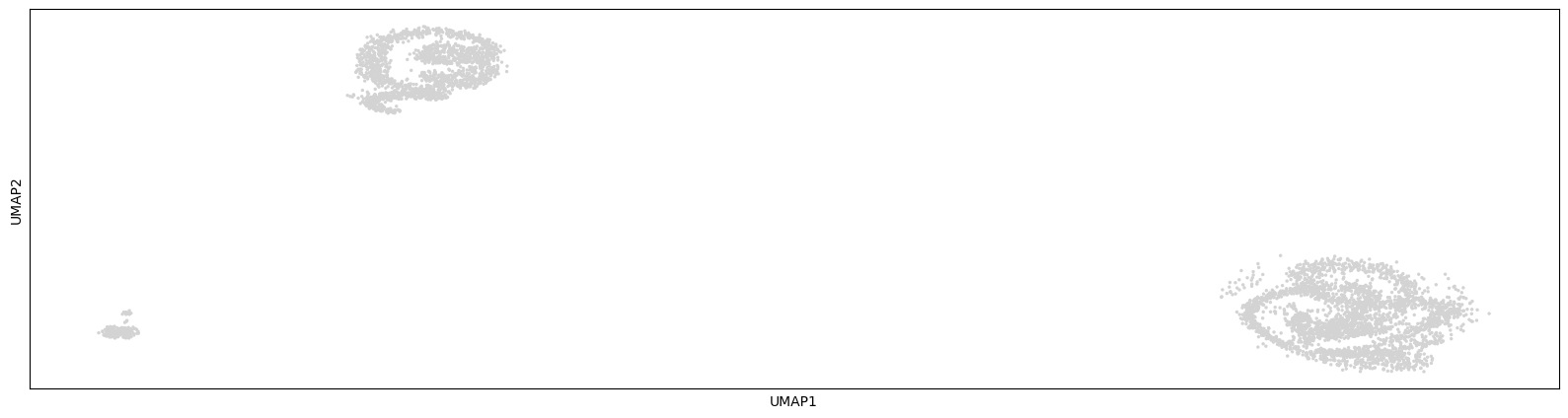
sc.pl.umap(adata)